+977 9868136870 (Shankar) Mail Us | Make an Enquiry
Mardi Himal Trek 2026: Complete Guide, Cost & Itinerary
Mardi Himal Trek in 2026: An Introduction
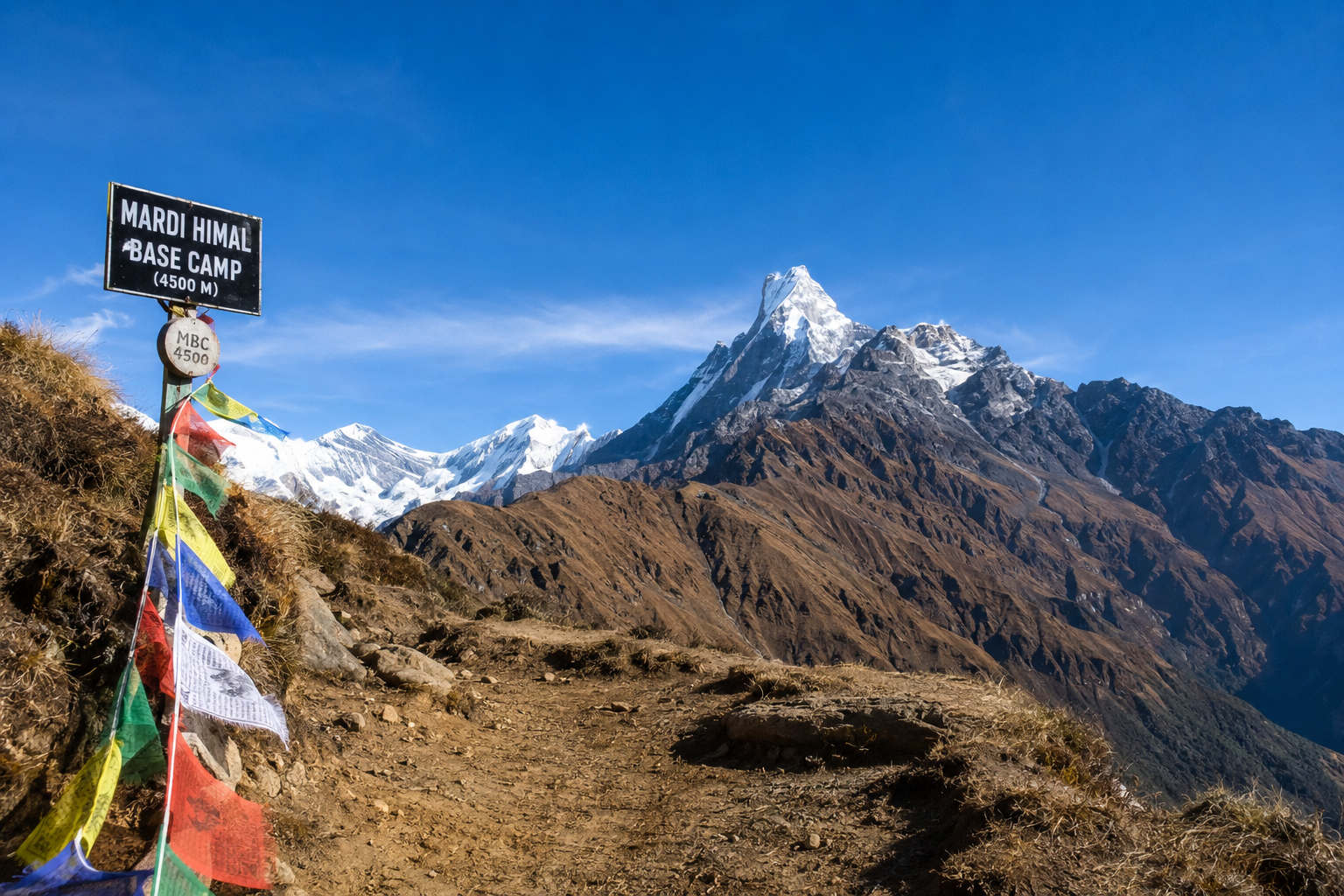 The Mardi Himal Trek has become one of Nepal's most appealing short Himalayan adventures, particularly for travelers looking for spectacular mountain scenery without committing to a long, demanding expedition. Located in the Annapurna region north of Pokhara, the trek combines peaceful forest trails, traditional mountain settlements, alpine landscapes and remarkably close views of some of the Himalayas' most famous peaks.
What makes Mardi Himal special is the dramatic change in scenery over a relatively short distance. The trail begins among green hills and rhododendron forests before gradually climbing toward the alpine zone, where the landscape opens into sweeping mountain views. From the upper sections of the trail, trekkers can see Mardi Himal, Machhapuchhre (Fishtail), Annapurna South, Hiunchuli and other peaks of the Annapurna range.
Unlike some of Nepal's longer classic treks, Mardi Himal can generally be completed within about five to seven days depending on the itinerary, walking pace and starting and ending points. This makes it particularly attractive to travelers who have limited time in Nepal but still want a genuine Himalayan trekking experience.
For 2026, Mardi Himal remains an excellent choice for travelers seeking a relatively short trek with a strong combination of scenery, culture and adventure. Since the route lies within the Annapurna Conservation Area, trekkers should make sure they have the required permits and follow the current trekking regulations. The Nepal Tourism Board currently lists Mardi Himal among the Annapurna-region routes where a licensed guide and agency-issued TIMS card are required.
Where Is Mardi Himal?
Mardi Himal is located in the Annapurna region of north-central Nepal, close to the famous Machhapuchhre mountain. The trekking route is generally accessed from Pokhara, one of Nepal's major tourism destinations.
Pokhara is the natural gateway to the trek and is easily connected with Kathmandu by road and air. From Pokhara, trekkers travel toward the trailhead before beginning the ascent through villages and forests toward Mardi Himal Base Camp.
The location is one of the reasons the trek is so convenient. Travelers can combine several days in the mountains with time exploring Pokhara's lakeside atmosphere, viewpoints, cafés and other attractions.
The Mardi Himal route also falls within the broader Annapurna Conservation Area. Nepal Tourism Board identifies the Annapurna Conservation Area as a major trekking and mountaineering destination and lists March–May and September–November among its best seasons.
Why Trek Mardi Himal in 2026?
Mardi Himal offers a different experience from Nepal's more heavily traveled trekking routes. While the trail has become increasingly popular, it still provides sections where trekkers can enjoy forests, mountain ridges and quiet Himalayan landscapes away from the busiest trails.
The biggest attraction is the combination of short duration and high-quality mountain scenery. You do not need several weeks to experience the high Himalayas here.
The trek is especially appealing because you can experience several landscapes within a single journey. Lower sections pass through forests filled with rhododendrons and other vegetation, while higher elevations reveal open grasslands, rocky slopes and panoramic mountain ridges.
Another major attraction is the view of Machhapuchhre, commonly known as Fishtail. The distinctive double summit is one of the most recognizable mountains in Nepal and becomes increasingly impressive as the trail climbs toward High Camp.
For photographers and nature lovers, the changing landscape creates excellent opportunities throughout the trek. Sunrise and sunset from the higher viewpoints can be particularly memorable when weather conditions are clear.
Mardi Himal Trek Highlights
The experience is about more than reaching a particular altitude. The journey itself is one of the main attractions.
Some of the highlights include:
- Panoramic views of Machhapuchhre (Fishtail)
- Close views of Mardi Himal and the Annapurna range
- Rhododendron and Himalayan forests
- Traditional mountain villages and teahouses
- Beautiful ridge walking
- Sunrise and sunset views from the upper trail
- Peaceful landscapes compared with some of Nepal's busier trekking routes
- The opportunity to experience Pokhara and the Annapurna region in the same trip
- A relatively short Himalayan trekking itinerary
Mardi Himal Trek Difficulty
The Mardi Himal Trek is generally considered a moderate trek, but it should not be mistaken for an easy hike.
The difficulty comes mainly from continuous uphill and downhill walking, uneven terrain and the increasing altitude. The final sections toward the upper viewpoint can be particularly demanding because of the steep trail and thinner air.
Previous trekking experience is helpful but not essential. A reasonably fit traveler who prepares properly can undertake the trek, preferably with a qualified guide and appropriate acclimatization.
The Nepal Tourism Board specifically advises trekkers to take altitude-related risks seriously, noting that acute mountain sickness can develop above 3,000 meters.
Fitness preparation before the trek should focus on building endurance rather than simply trying to walk long distances once or twice. Regular walking, hiking, stair climbing and cardiovascular exercise can help prepare your body for consecutive days on the trail.
Mardi Himal Trek Altitude
One of the defining characteristics of the trek is the rapid change in elevation.
The exact highest point depends on the itinerary and viewpoint reached. Many itineraries take trekkers toward Mardi Himal Base Camp and the Mardi viewpoint at approximately 4,500 meters, although exact elevations can vary between maps, routes and trekking operators.
Because the trek reaches considerable altitude in a relatively short number of days, acclimatization and a sensible walking pace are important.
Do not treat altitude as a competition. Walking slowly, staying hydrated, eating properly and informing your guide if you feel unwell are far more important than reaching a destination quickly.
Mardi Himal Trek Route and Itinerary
A standard Mardi Himal itinerary generally takes around five to seven days. The exact schedule can vary depending on transportation, trail conditions, acclimatization preferences and whether you want to spend additional time at the viewpoint.
Day 1: Pokhara to Kande and Trek to Forest Camp
The journey usually begins with a drive from Pokhara toward the trailhead around Kande or a nearby starting point.
From Kande, the trail enters the hills and gradually climbs through forested terrain. Depending on the itinerary, the first overnight stop may be at a forest settlement such as Forest Camp.
This first day introduces you to the character of the trek: stone steps, forest paths, mountain air and increasingly impressive views.
Day 2: Forest Camp to Low Camp
The trail continues upward through dense Himalayan forest.
As you gain altitude, the vegetation begins to change and the views become more open. Rhododendron forests are particularly attractive during spring when the flowers are in bloom.
Low Camp is an important stop because the landscape begins to feel distinctly alpine, with views toward Machhapuchhre and the surrounding mountains.
Day 3: Low Camp to High Camp
This is one of the most scenic sections of the Mardi Himal Trek.
The forest gradually gives way to open ridges, and the mountains become much more prominent. The trail continues along a ridge with spectacular views of Machhapuchhre and the Annapurna range.
High Camp is normally the highest overnight settlement on the route and provides an excellent base for the following day's early-morning hike toward the upper viewpoint.
Day 4: High Camp to Mardi Viewpoint/Upper Base Camp and Return
Many trekkers wake early to hike toward the upper viewpoint for sunrise.
The trail becomes steeper and more exposed as you climb higher. On a clear morning, the view from the ridge can be extraordinary, with Machhapuchhre dominating the foreground and the Annapurna mountains extending across the horizon.
After spending time at the viewpoint, trekkers return toward High Camp or descend to a lower overnight point depending on the chosen itinerary.
Weather conditions can significantly affect visibility, so reaching the viewpoint does not guarantee a panoramic mountain view.
Day 5: High Camp to Siding and Drive to Pokhara
The descent provides a completely different experience from the ascent.
The landscape becomes greener as you lose altitude, and the trail eventually reaches lower villages such as Siding.
From Siding, transportation can take you back toward Pokhara, completing the main trekking section.
Some itineraries add an additional overnight stop or divide the descent into multiple days for a more relaxed experience.
Best Time for Mardi Himal Trek in 2026
Choosing the right season can make a major difference to your Mardi Himal experience.
The two most favorable trekking periods are generally spring and autumn.
Spring: March to May
Spring brings warmer conditions at lower elevations and blooming rhododendrons across the hills. March can still be cold at higher elevations, while April and May generally provide comfortable trekking conditions before the monsoon becomes dominant.
The forests can be particularly beautiful during this period.
Autumn: September to November
Autumn is widely regarded as one of the best seasons for trekking in Nepal.
After the monsoon, the atmosphere often becomes clearer, creating excellent conditions for mountain views. October and November are especially popular for Himalayan trekking.
Nepal Tourism Board identifies September–November and March–May as the best seasons for the Annapurna Conservation Area.
Winter: December to February
Winter trekking is possible, but conditions at higher elevations can become considerably colder and snow can affect the upper sections of the route.
Trekkers choosing winter should be properly equipped and should check current weather and trail conditions before departure.
Monsoon: June to August
The monsoon season brings substantial rainfall to Nepal. Trails can become muddy and slippery, while clouds and rain can reduce mountain visibility.
Lower sections may also experience wet conditions and leeches.
For travelers primarily interested in clear Himalayan panoramas, spring and autumn are generally preferable.
Nepal Tourism Board notes that roughly 80% of Nepal's rainfall occurs during the June–September monsoon period.
Mardi Himal Trek Permits in 2026
Because Mardi Himal lies in the Annapurna region, trekkers need the relevant conservation-area entry documentation and TIMS requirements.
For 2026, the Nepal Tourism Board lists Mardi Himal Trek among the Annapurna routes covered by the revised TIMS provisions, which require trekkers to be accompanied by a licensed trekking guide and to obtain a trekking-agency-issued TIMS card.
The current Nepal Tourism Board information lists the Annapurna Conservation Area entry fee for foreign visitors at NPR 2,000 per person. Fees and regulations can change, so travelers should verify the latest requirements before departure.
Important permit information includes:
- Annapurna Conservation Area entry permit
- TIMS card
- Passport copy and required photographs/details for documentation
- Licensed trekking guide
- Registered trekking agency arrangements where required
The Nepal Tourism Board advises trekkers to obtain the necessary documentation before starting their trek.
Mardi Himal Trek Cost in 2026
The total cost of the Mardi Himal Trek depends on the itinerary, group size, accommodation standard, transportation, guide and porter services, permits and personal expenses.
A budget trek and a premium private trek can have noticeably different prices.
When comparing packages, do not look only at the headline price. Check exactly what the package includes.
A typical package may cover:
- Transportation between Pokhara and the trekking trailhead
- Accommodation during the trek
- Meals during trekking days
- Licensed trekking guide
- Porter service, depending on the package
- TIMS card and applicable permits
- Trekking agency service charges
- Basic first-aid support
- Government taxes and applicable fees
Additional personal expenses may include snacks, beverages, charging, Wi-Fi, hot showers, tips, travel insurance and emergency evacuation.
For a 2026 booking, it is best to request a detailed quotation from a registered trekking agency because prices can change according to transportation costs, accommodation availability, group size and the season.
Accommodation During the Mardi Himal Trek
Accommodation is generally provided in local teahouses and lodges. The facilities are simpler than those found in hotels in Pokhara or Kathmandu. Rooms are generally basic, and shared bathrooms are common at higher elevations.
The experience, however, is part of the appeal. Staying in mountain teahouses allows travelers to meet fellow trekkers and experience the hospitality of communities along the route.
During peak trekking seasons, popular overnight stops can become busy. Booking through a trekking agency or arranging accommodation in advance can be useful, especially for private groups and travelers with specific requirements.
Food and Drinking Water
Teahouses along the route generally serve a combination of Nepali and familiar international trekking meals. Dal bhat is one of the most practical options because it provides carbohydrates, protein and energy for long walking days. Other common choices may include noodles, pasta, rice dishes, soups, eggs and breakfast items.
At higher elevations, food options may be more limited than in Pokhara.
For drinking water, trekkers should use properly treated or purified water. Carrying a reusable bottle and using a reliable water-purification method can reduce plastic waste while helping you stay hydrated.
What to Pack for Mardi Himal Trek
Packing should focus on keeping your backpack practical rather than carrying everything you own.
Essential items generally include:
- Comfortable trekking boots with good grip
- Warm layers and a waterproof outer layer
- Thermal base layers for colder nights
- Trekking trousers and comfortable hiking clothes
- Warm hat, gloves and socks
- Sunglasses and sunscreen
- Reusable water bottles
- Headlamp
- Basic personal first-aid supplies
- Personal medications
- Sleeping bag suitable for the expected temperatures
- Rain protection
- Trekking poles
- Power bank
- Passport and permit/document copies
- Travel insurance details
Your exact clothing requirements will depend heavily on the season.
Is Mardi Himal Trek Suitable for Beginners?
Yes, Mardi Himal can be a suitable introduction to Himalayan trekking for people with reasonable fitness and preparation.
However, "beginner-friendly" does not mean effortless. The route contains steep sections, long walking days and significant altitude gain. Beginners should prepare physically, use a sensible itinerary and avoid rushing.
A licensed guide is particularly valuable for first-time trekkers because they can help with navigation, local conditions, accommodation and altitude-related concerns.
The current Nepal Tourism Board requirements also mean that Mardi Himal trekkers should plan around the applicable guide and TIMS rules rather than assuming they can independently hike the route.
Mardi Himal Trek vs Annapurna Base Camp Trek
Mardi Himal and Annapurna Base Camp are both located in the Annapurna region, but they offer different trekking experiences. Mardi Himal is generally the better choice for travelers who want a shorter itinerary, dramatic ridge views and a quieter mountain experience.
Annapurna Base Camp, on the other hand, takes trekkers into a famous Himalayan sanctuary surrounded by towering peaks and is generally chosen by travelers who want the classic base-camp experience.
Mardi Himal is particularly attractive when the priority is short duration + panoramic mountain views + varied landscapes.
Mardi Himal Trek for Photographers
Mardi Himal is an excellent destination for landscape photography. The trail changes dramatically throughout the journey. Lower sections offer forests and village scenes, while higher elevations provide wide Himalayan panoramas. The ridge above Low Camp and the approach toward High Camp are especially rewarding for photographers because Machhapuchhre becomes increasingly prominent.
For the best results, carry spare batteries or a power bank and protect cameras and other electronics from rain, cold and condensation. Early mornings are often particularly valuable for photography because mountain visibility can change throughout the day.
Responsible Trekking on the Mardi Himal Route
The growing popularity of Mardi Himal also means that responsible tourism is increasingly important. Trekkers should respect local communities, avoid unnecessary plastic waste and follow established trails rather than creating shortcuts. The mountains are not simply a backdrop for photographs. They are home to communities, wildlife, forests and fragile ecosystems.
A responsible trekker should:
- Carry reusable water bottles where practical
- Avoid leaving plastic and other waste behind
- Respect local customs and private property
- Use designated trails
- Follow guide and local safety instructions
- Avoid disturbing wildlife
- Use water and electricity responsibly
- Support local teahouses and businesses
- Safety and Altitude Considerations
Altitude is one of the most important factors to consider on Mardi Himal. As elevation increases, the body has less available oxygen. Altitude sickness can affect anyone, regardless of fitness level.
The safest approach is to ascend gradually, pay attention to your body's condition and communicate immediately with your guide if you experience concerning symptoms.
The Nepal Tourism Board recommends trekking in groups, staying on designated routes and carrying items such as a raincoat, torch and first-aid kit. It also warns that acute mountain sickness can become serious at higher elevations.
Travel insurance that covers trekking at the altitude of your itinerary is strongly recommended. Travelers should also understand the emergency procedures offered by their trekking agency before starting the trek.
Travel Insurance for Mardi Himal Trek
Travel insurance is an important part of preparing for a Himalayan trek. A suitable policy should be checked carefully for trekking coverage and the maximum altitude covered. Travelers should also understand whether emergency medical treatment and evacuation are included.
Do not assume that a standard holiday insurance policy automatically covers trekking at high altitude. Keep your insurance details accessible throughout the trek.
How to Prepare for Mardi Himal Trek
Preparation does not need to be complicated. In the weeks before departure, build your endurance through regular walking and hiking. Include uphill and downhill sections when possible because trekking involves both. Practice carrying a backpack with some weight so that your body becomes accustomed to trekking with equipment.
It is also useful to break in your trekking boots before arriving in Nepal. New footwear can cause discomfort during long walking days. Most importantly, approach the trek with patience. Himalayan trekking is not about speed. The goal is to reach your destination safely while enjoying the journey.
How Many Days Do You Need for Mardi Himal?
A typical Mardi Himal Trek can be completed in around 5–7 days, depending on the starting point, route, walking pace and transportation arrangements. A shorter itinerary is possible for experienced and physically prepared trekkers, but rushing the route is generally not advisable.
A slightly longer itinerary gives you more flexibility and can make the trek more enjoyable. For first-time trekkers, a balanced itinerary with appropriate acclimatization and reasonable walking hours is preferable to trying to complete the route in the minimum possible time.
Best Mardi Himal Trek Itinerary for 2026
For most travelers, a 6-day itinerary provides a good balance between trekking, scenery and flexibility.
A practical structure is:
Day 1: Pokhara – Kande – Forest Camp
Day 2: Forest Camp – Low Camp
Day 3: Low Camp – High Camp
Day 4: High Camp – Mardi viewpoint/upper section – descent
Day 5: Descent toward Siding
Day 6: Siding – Pokhara
The exact overnight locations may change depending on trail conditions, accommodation availability and the trekking company's operational route.
Frequently Asked Questions
Is Mardi Himal Trek open in 2026?
Mardi Himal is an established trekking route in Nepal and is included by the Nepal Tourism Board among the Annapurna-region routes covered by current TIMS requirements. Travelers should check current trail, weather and permit conditions before departure.
What is the best month for Mardi Himal Trek?
October and November are excellent choices for clear autumn conditions. March, April and May are also favorable, with spring offering the additional attraction of blooming rhododendrons.
How difficult is Mardi Himal Trek?
It is generally considered a moderate trek. The route includes steep ascents, descents and high-altitude walking, so reasonable fitness and preparation are important.
Can beginners do Mardi Himal Trek?
Yes. Beginners with adequate fitness can undertake the trek, but they should not underestimate the altitude and terrain. A gradual itinerary and experienced guide are recommended.
Do I need a guide for Mardi Himal Trek in 2026?
Yes. Under the current revised TIMS provisions published by the Nepal Tourism Board, Mardi Himal is among the Annapurna routes requiring trekkers to be accompanied by a licensed trekking guide and carry an agency-issued TIMS card.
What is the highest point of Mardi Himal Trek?
Many itineraries reach the Mardi viewpoint at approximately 4,500 meters, although the exact highest point can vary depending on the route and turnaround point.
How much does Mardi Himal Trek cost in 2026?
There is no single fixed price. The cost depends on the number of trekking days, group size, transportation, accommodation, guide and porter services, permits and package inclusions. A detailed quotation from a registered trekking agency is the best way to determine the current price.
Is Mardi Himal Trek worth it?
For travelers looking for a relatively short Himalayan adventure with spectacular mountain scenery, forest trails, ridge walking and access from Pokhara, Mardi Himal is an excellent option.
Final Thoughts: Is Mardi Himal Trek Worth Doing in 2026?
The Mardi Himal Trek in 2026 offers one of the most rewarding ways to experience the Annapurna region without spending several weeks in the mountains.
Its appeal comes from the journey itself. Within a matter of days, the landscape transforms from green hills and rhododendron forests into high Himalayan ridges overlooking Machhapuchhre and the Annapurna range.
It is challenging enough to feel like a genuine Himalayan adventure while remaining accessible to travelers who prepare properly.
For those with limited time in Nepal, Mardi Himal offers an especially attractive combination: Pokhara, peaceful mountain trails, traditional villages, spectacular Himalayan views and a relatively short trekking itinerary.
If you are planning your Nepal adventure for 2026 and want a trek that balances scenery, culture, adventure and time efficiency, Mardi Himal deserves a place near the top of your list.
Before booking, always confirm the latest permit requirements, TIMS regulations, trail conditions, transportation arrangements and weather information, as trekking policies and conditions can change.
Recent Post
-

Festivals and Cultural Highlights of Nepal – A Celebration of Devotion and Diversity
Tourism In Nepal -
A Guide to Responsible Trekking: Leave No Trace in Nepal
Trekking Tips -
Top 10 Trekking Routes in Nepal for 2025
Trekking Tips -

Everest Base Camp vs Annapurna Base Camp Trek | Which is Best for You?
Tourism In Nepal -
Save The Himalaya
Trekking Tips -
Adventures Beyond the Summit: Things to Do on Mount Everest
Trekking Tips -
Discover the majestic Annapurna Region: A Trekker's Paradise
Trekking Tips -
Trek To Everest Region
Trekking Tips -

Langtang Valley Trek in 2026 | Complete Travel Guide
Trekking Tips -
Nepal: Where Nature’s Majesty Meets Timeless Beauty
Tourism In Nepal
Associated and certified